Renewable Tech
Feb 23, 2026
Beyond the Panels: The New Era of High-Efficiency Generation
From perovskite tandem cells to floating offshore giants; how the "basics" of solar and wind are being reinvented for 2026.

Renewable Tech
Feb 23, 2026
From perovskite tandem cells to floating offshore giants; how the "basics" of solar and wind are being reinvented for 2026.
For most of the past two decades, solar and wind power followed a simple narrative: more panels, more turbines, lower costs. That model delivered extraordinary results. India's total installed power capacity crossed 537 GW in April 2026, with renewable energy now contributing 42.2% of the total installed capacity. Solar alone crossed 141 GW. Wind stands at 55 GW. These are numbers that seemed impossible a decade ago.
But the next chapter of the energy transition is not about more of the same. It is about fundamentally better, panels that convert a third of all sunlight they receive, turbines that operate in waters previously considered unreachable, and AI systems that squeeze every available watt from assets that cost hundreds of millions of dollars to build.
For industrial energy buyers in India, this shift matters enormously. The technology you deploy today will determine your energy cost structure and carbon footprint for the next 25 years. Here is what the frontier looks like.
Standard silicon solar panels have powered the first wave of the global solar boom. They are proven, bankable, and cheap. The best commercial silicon panels available today convert roughly 22–24% of incoming sunlight into electricity, a figure that has improved steadily for decades but is now approaching a hard physical limit.
That limit is known as the Shockley-Queisser limit, the theoretical maximum efficiency for a single-junction silicon solar cell, approximately 29%. Most commercial panels are still several percentage points below it, and closing that gap gets progressively harder and more expensive.
The industry's answer is to stop trying to squeeze more from silicon alone, and instead to layer it with a new class of materials.
Perovskite solar cells are made from materials with a specific crystal structure that exhibits outstanding light-absorbing properties. Unlike silicon, which is manufactured through an energy-intensive process at extremely high temperatures, perovskite layers can be deposited at low temperatures and potentially printed, like ink, onto surfaces.
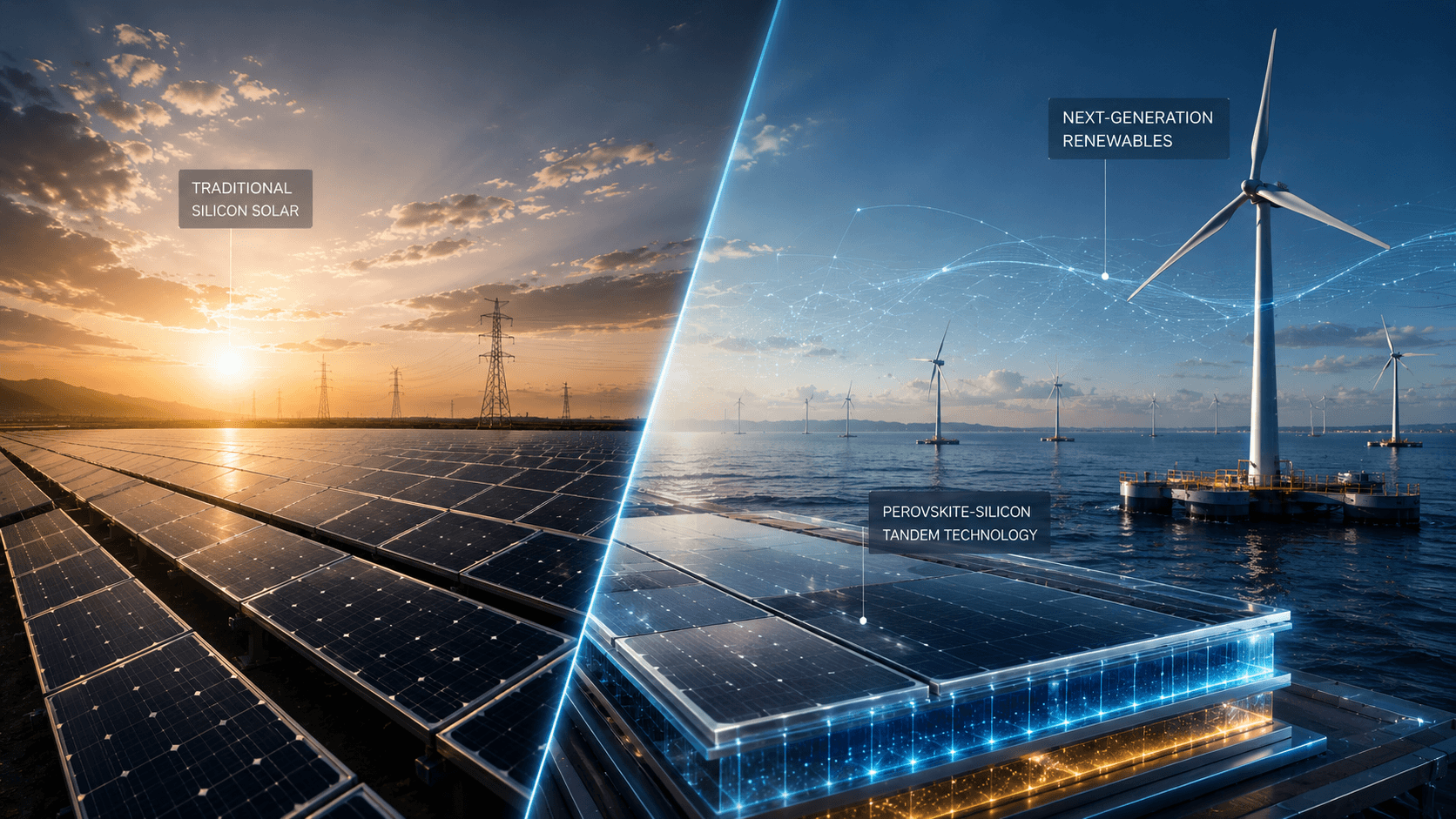
The efficiency numbers are extraordinary. Perovskite-silicon tandem cells, where a perovskite layer is stacked on top of a silicon base, have reached certified efficiencies of 34.85%, set by LONGi Green Energy, which holds the current world record. This surpasses the Shockley-Queisser single-junction theoretical limit, because the tandem architecture works differently: the perovskite layer absorbs blue and green light, while the silicon base captures the red and infrared spectrum. Together, they harvest a far wider range of the solar spectrum than either material can achieve alone.
For industrial context: a tandem panel at 34% efficiency generates roughly 40–50% more power from the same physical area as a standard 22% silicon panel. For a rooftop installation on a data center, a telecom facility, or a manufacturing plant with constrained roof space, this is not a marginal improvement, it is a fundamental change in what is feasible.
Oxford PV, the first mover in commercial perovskite-silicon production, is already operating a production line in Germany. Hanwha Qcells has hit 28.6% tandem efficiency on commercial-size wafers and is targeting commercial production in 2026. LONGi, the world's largest solar manufacturer, holds the record and has the scale to reshape the market when it moves to production.
The honest caveat: at full industrial scale, perovskite-silicon panels are not yet on every distributor's shelf. The gap between a certified lab record and a 25-year outdoor-warranted commercial product is real, and the industry is actively working through stability and durability challenges. But the trajectory is clear, and the timeline to widespread commercial availability is measured in years, not decades.
One of the most consequential developments enabled by perovskite chemistry is the move toward flexible, lightweight solar films that can be laminated onto curved or irregular surfaces.
Traditional rigid silicon panels require flat, structurally reinforced mounting surfaces. They cannot conform to the curved roof of an agricultural vehicle, the wing surface of a surveillance drone, or the hull geometry of a coastal vessel. Thin-film perovskite and CIGS technologies change this completely.
The implications for Cosmos Power's core sectors are direct:
Agriculture and construction: Flexible solar films can be integrated into the bodywork of heavy equipment: tractors, excavators, mobile site offices. Providing supplementary power generation without dedicated panel infrastructure.
Defence and remote operations: Lightweight flexible panels can be deployed rapidly in forward operating environments where traditional panel installation is impractical.
Marine: Solar-generating hull panels and deck surfaces on coastal vessels, combined with hydrogen fuel cells for propulsion, point toward a zero-emission maritime operating model.
This is not science fiction. It is engineering that is commercially available today in specific applications, with broader industrial deployment accelerating through 2026 and beyond.
India's coastline stretches 7,600 kilometres, facing some of the most consistently energetic wind resources in Asia. Yet offshore wind has barely been touched.
As of early 2026, India's installed wind capacity stands at 55 GW, but virtually all of it is onshore. The offshore frontier is only now beginning to open, with transmission planning completed for an initial 10 GW of offshore evacuation capacity, 5 GW each for Gujarat and Tamil Nadu. India's Ministry of New and Renewable Energy has launched an India-UK Offshore Wind Taskforce and plans to issue tenders for the Tamil Nadu coast, where preliminary LiDAR data indicates a Capacity Utilisation Factor of 45–50% significantly higher than most onshore wind sites.
The reason offshore matters so much is not just capacity. It is consistency. Offshore wind resources are stronger, more uniform, and less affected by terrain. A 45–50% CUF means a turbine is generating at nearly half its rated capacity on average across the year, compared to 25–30% for many onshore sites. For industrial energy buyers who need reliable baseload power, this difference is enormous.
The technology enabling India's offshore push is floating wind foundations, platforms that anchor turbines in deep water where fixed-bottom structures are not viable. Unlike fixed-bottom turbines limited to shallow coastal waters, floating foundations can access the deep-sea zones where India's best offshore wind resources sit. Gujarat and Tamil Nadu alone are estimated to hold around 70 GW of offshore wind potential enough to power over 50 million homes.
The challenges are real: offshore wind requires specialised port infrastructure, marine logistics, and robust commercial frameworks. Costs are higher than onshore. But the capacity utilisation advantages and the sheer scale of the resource make offshore wind a strategic necessity for India's long-term energy security, not just an interesting option.
Hardware efficiency improvements matter. But the most immediate opportunity for industrial energy operators is often in the software layer that manages existing assets.
Modern wind turbines use AI-powered predictive pitch control algorithms that adjust blade angles in real time based on wind speed, direction, turbulence, and load data. The result is measurably higher energy capture from the same physical turbine, with reduced mechanical stress and extended asset life.
For solar arrays, AI-driven maximum power point tracking, soiling detection, and predictive maintenance have moved from optional features to standard practice in professionally managed installations. The difference between a well-managed and a poorly managed solar array of the same hardware can be 10–15% in annual generation.
For large industrial energy consumers like data centers, telecom infrastructure, manufacturing plants, the economic impact of optimised generation management across a multi-MW installation runs to crores of rupees annually. This is the category of value that Cosmos Power's AI energy management layer is designed to capture.
The technology landscape described above creates a specific set of strategic choices for industrial energy buyers in 2026:
Deploy proven technology with a roadmap to upgrade. Standard silicon solar and onshore wind are mature, bankable, and cost-effective today. Structuring installations with upgrade pathways, roof space reservations, inverter infrastructure sized for future higher-efficiency panels preserves optionality.
Take the software layer seriously. AI-optimised energy management is available today and delivers measurable ROI on existing assets. It is not a future promise, it is current capability.
Watch the offshore wind tender cycle. For large industrial consumers in coastal states, Tamil Nadu and Gujarat offshore wind capacity coming to market over 2026–2028 represents a significant opportunity to secure long-term power purchase agreements on highly consistent generation.
Consider flexibility as an asset. As perovskite flexible films and bifacial panels become more accessible, unconventional surface areas: rooftops, vehicle fleets, perimeter structures become potential generation surfaces. Energy that was previously wasted as heat on a rooftop becomes a productive asset.
At Cosmos Power Technologies, we treat high-efficiency generation hardware as the foundation layer of a larger system. A perovskite tandem panel that generates 40% more power than a standard silicon panel is only as valuable as the storage, management, and distribution infrastructure that captures and deploys that power intelligently.
This is why our platform integrates generation assets with BESS storage, AI energy management, and for sectors where grid reliability is non-negotiable hydrogen backup through VapourGen PEM systems. The result is not a collection of components. It is an energy infrastructure that operates as a coordinated system, delivering the 24/7 reliability that industrial operations demand.
The "basics" of solar and wind are being reinvented. The question for Indian industry is not whether to engage with this reinvention, it is how to do so with the right infrastructure partner and the right commercial structure.
The era of incremental improvement in solar and wind is over. What is replacing it is a genuine technology discontinuity, perovskite tandems breaking the silicon efficiency ceiling, floating turbines unlocking India's deep-water wind resources, and AI systems extracting performance gains from every installed asset.
For industrial energy buyers, the window to build high-efficiency, future-ready infrastructure is open right now, before these technologies become commoditised, before offshore wind capacity is fully subscribed, and while India's renewable energy policy environment remains highly favourable.
India's total installed power capacity crossed 537 GW in April 2026, with renewable energy now contributing 42.2% of the total mix. The infrastructure race is on. The companies that move now will define the next generation of Indian industrial energy.
Want to understand how next-generation solar and storage infrastructure could work for your operation? Talk to the Cosmos Power team.